
The Weight of Moving
- Ivana Petersen
- 1 day ago
- 4 min read

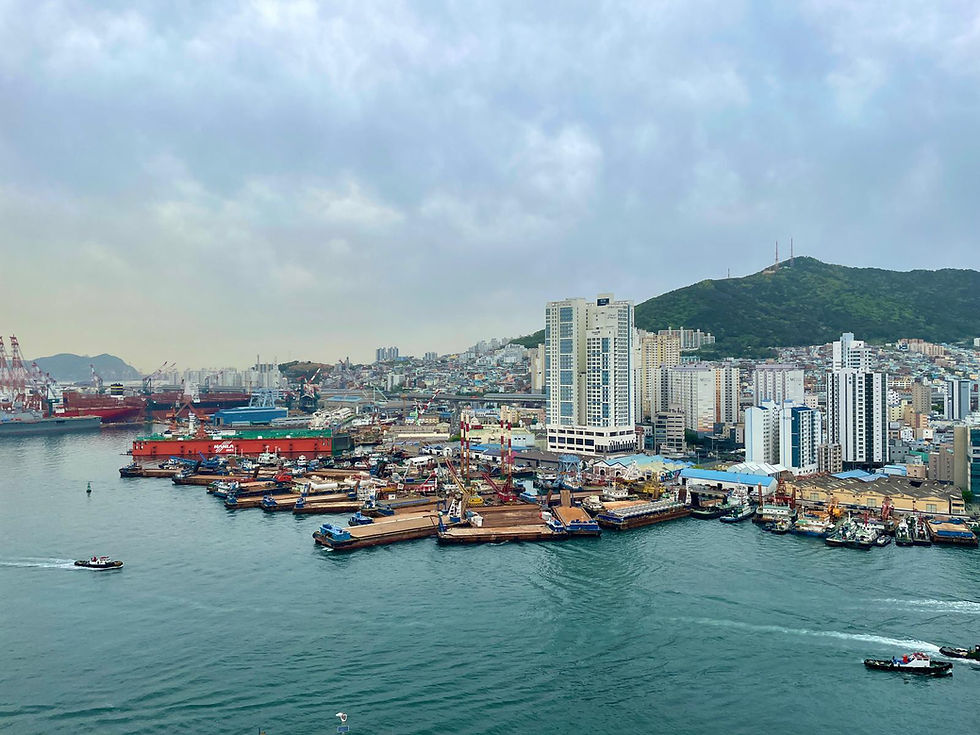
We left for Busan on a Sunday.
From Seoul — the city that had taken my whole soul in a single moment, that had filled my cup with noise and jazz and cherry blossoms and a crab seller clapping her hands at us in a night market — we packed our bags, called an Uber, and moved on.
The way we always do. The way we have learned to do.
The trunk was a puzzle of luggage. The train station felt vast and slightly hostile, the way unfamiliar train stations always do — too many signs in the wrong language, too many directions to choose from, the particular low-grade stress of navigating a new system with all your worldly belongings in tow. The train was full of familiar faces from our travelling community, which helped. Two and a half hours passed quickly. And then, almost before I had time to prepare myself for it, I was rolling suitcases down escalators again, scanning for taxis, beginning the whole choreography of arrival from the beginning.
This part — the physical moving, the logistics, the travel itself — I have made my peace with. It is the landing that gets me every time.
There are the practical resistances too — the accumulation of small daily frictions that, individually, are nothing, but together create a particular kind of exhaustion. Something in the accommodation has been making some of us unwell. The gym I had researched before arriving turned out not to be what I needed, and the alternative doesn’t open until eleven in the morning, which dismantles the entire architecture of a routine I have spent years carefully constructing. The weather requires a different wardrobe than I had planned for. The kitchen has too few glasses and no knives worth using. The bed is made the way beds are made in this part of Korea, which is to say differently from how I am used to, which is to say my body notices every night.
I know how small these things sound written down. I know, better than almost anyone, that I have chosen this life — chosen it actively and repeatedly, knowing exactly what it costs. What no one tells you, and what I am still learning to say out loud, is that the choosing doesn’t make the cost disappear. You can love something deeply and still find it hard. You can want the life you have and still, occasionally, want a kitchen with a proper knife and a gym that opens at six in the morning and a bed that feels familiar.
This is the part of nomadic living that doesn’t make it into the beautiful photographs. The week where you haven’t found your coffee shop yet. The morning where the routine you depend on to feel like yourself simply isn’t available in this city, in this configuration, and you have to decide who you are without it.
And then, underneath all of it, the thing that made everything else heavier.
This week brought news of illness in our family. The kind of illness that changes the shape of everything — that makes you sit very still for a moment, recalibrating all your plans, all your timelines, all your assumptions about the future. A family member. Terminal. And with that word, a whole new layer of questions arriving all at once: how do we structure the rest of our year around this? How do we give our children the chance to be present, to know this person fully, to carry something of them forward? How do I hold my own grief and the children’s needs and my partner’s feelings and my own fierce, stubborn desire to keep living the life we have built — all at the same time, in a small apartment in Busan, in a city that hasn’t opened itself to me yet?
I am not ready to stop. I know that about myself with a clarity that surprised me a little this week. Even in the heaviest moments of this transition, even with the grief sitting quietly alongside everything else, I felt it: the pull toward movement, toward the next place, toward the particular aliveness that this life gives me. I am not willing to surrender that. Not yet. Not even now.
But I am also learning — slowly, imperfectly, across all these countries and all these transitions — that holding two things at once is not a contradiction. That you can want to keep moving and also need to stay, want adventure and also need familiarity, love this life and also find it hard, be grateful and also be sad.
This week I have been all of those things simultaneously, and none of them cancelled the others out.
Transitions have always been where I meet myself most honestly.
Not in the beautiful moments — the cherry blossoms in Gangnam, the jazz in the Seoul coffee shop, the crab seller’s delight — but in the in-between spaces. The train station with too many signs. The apartment that smells slightly wrong. The morning when the routine doesn’t work and you have to find out what remains of you when the scaffolding is removed.
What remains, I keep discovering, is more than I expected.
A stubbornness. A curiosity that survives even the difficult weeks. A capacity to make anywhere feel like home eventually, even when eventually feels very far away on a rainy Thursday in a city that hasn’t shown me its best side yet.
Busan, I am still waiting for you.
I suspect you have something to show me that I haven’t seen yet. I suspect, a few weeks from now, I will find the coffee shop that feels like mine, the running trail that makes me catch my breath, the corner of this city that explains why we came.
And when I do, I will have earned it.
The hard weeks are part of it too — the weight, the grief, the resistance.
They are not the opposite of the beautiful life.
They are what the beautiful life is actually made of.


Comments