
If Only
- Ivana Petersen
- 5 days ago
- 6 min read


There are places you fall into like a warm bath.
And there are places that hold you at arm’s length — politely, without malice, but firmly — as if to say: this is not yours, not quite, not yet.
Haeundae Beach is the second kind, for me.
I have been sitting with this for a few days now, turning it over, trying to understand where resistance comes from — because I think that question matters. It is not simply about whether a place is objectively beautiful or interesting or worthy of love. I have loved imperfect places fiercely. I have failed to love stunning ones. The difference, I am realising, has less to do with the place and more to do with a particular quality of freedom — the feeling of being able to roam and explore and feel safe doing so, of having the city yield to you rather than hold you back.
Two years ago on Koh Lanta, I felt genuinely trapped. No scooter, no easy way to move beyond the immediate perimeter of where we were staying, and something in me became very unsettled and uncomfortable in a way that went beyond inconvenience. It is remarkable, the difference a scooter can make — not just practically but psychologically. Mobility is a kind of freedom, and freedom is something I apparently need more than I had previously understood.
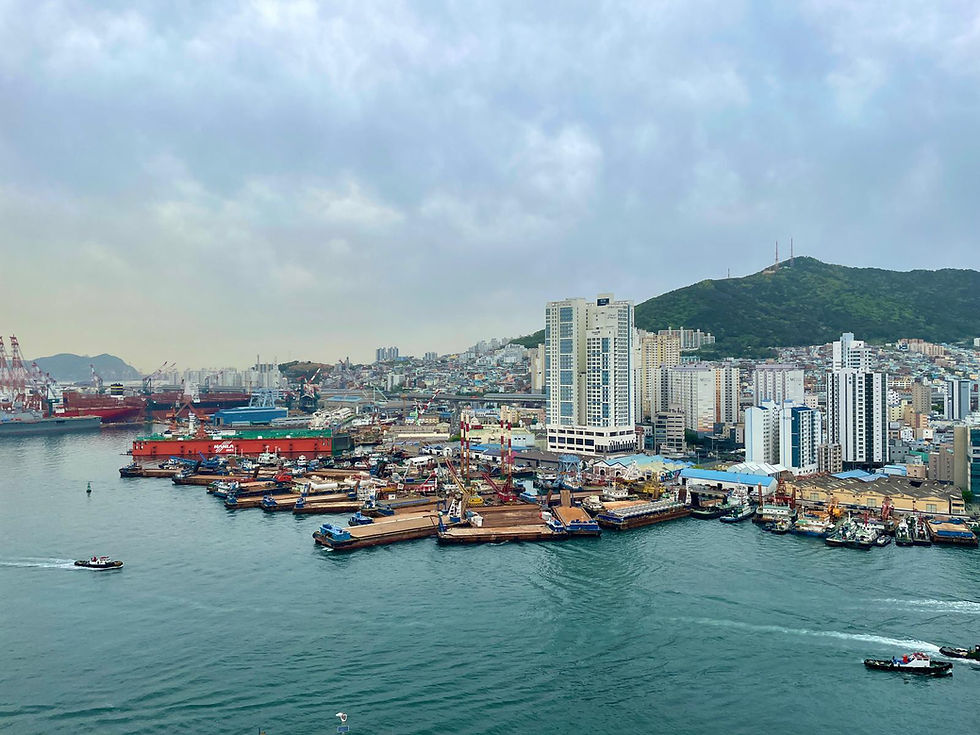
Haeundae does not feel like freedom. It feels like a tourist trap wearing the face of a beach town — no cosy streets winding unexpectedly into something charming, no small shops with personality, no coffee shop that feels like it was made for the kind of slow morning that keeps me sane. The things I reach for instinctively — comfort, coziness, a functional kitchen, a front door that opens onto something worth stepping out for — are simply not here, or not here in the form I know how to find them yet.
And here is the strange thing: I didn’t even particularly love Hualien when we were there.
It was fine. It was comfortable. It had what it had — straightforward amenities, a scooter that went where I needed it to go, coffee shops that were good enough, a kitchen that worked.
Nothing extraordinary. And yet standing here now, in the light of what I don’t have, I can see clearly what I did. The things I took for granted have become, in their absence, quite precious.
This is one of the more humbling lessons of this life: you often don’t know what a place gave you until you are somewhere that doesn’t.
Seoul gave me everything immediately — the energy, the coffee shops, the running trails, the sense of a city that wanted to be discovered. Hoi An gave it in a different register, slower and more golden. Antigua Guatemala. Others I carry quietly in my body as benchmarks for what a place can feel like when it fits. Haeundae has not given me that yet, and I am tired enough this week that yet feels like a very long word.
I want to be honest about the tiredness, because I think it deserves more than a passing mention.
I am burned out on the social intensity of this travelling format — the full calendars, the communal living, the constant proximity to other people’s energy and needs alongside my own. It is heavy right now. Not unbearable, not a crisis — just heavy, the way a coat becomes heavy when you have been wearing it too long without putting it down. I don’t have the will to explore and fill my days with new experiences the way I normally do. The curiosity that usually carries me through the difficult weeks of a new place is quieter than usual, and I am trying not to judge it for that.
My husband has had to move into a hotel room — probable mould in our building, which has been making some of us unwell — and so the family geometry of our daily life has shifted into something that requires deliberate navigation. Date planning. Pockets of time carved out intentionally. Reunions that have to be scheduled rather than simply happening, the way they do when you are all under one roof. I miss the ease of that, the ordinary togetherness of sharing a space, even a small one.
And somewhere underneath all of it, the knowledge we received last week about our family member — sitting there quietly, colouring everything, making time feel simultaneously more precious and more heavy than usual.
What is keeping me afloat, genuinely and specifically: my Hyrox training.
I am training for Hyrox in Oslo in September — a competition I pivoted to after missing the Chiba tickets by the cruelest of margins: my alarm didn’t go off when they went on sale, and they sold out before I could get one. The disappointment was real. But Oslo is now the goal, and having a goal — specific, physical, dated — turns out to be exactly the kind of anchor I need in weeks like this one. A programme, a purpose, a reason to get up and move my body through whatever city I find myself in, regardless of whether that city is cooperating with my happiness. This morning my husband and I ran ten kilometres past Mipo and the next two train stations, our friend alongside us, the sea beside us, and it was — unexpectedly, gratefully — one of the most beautiful runs I have had since we arrived in Korea. I love the running culture here. Something about it suits me. We showered, walked to a coffee shop that was good and far and worth the walk, and dragged our pleasantly exhausted bodies back through the afternoon.
That is a good day. Even in a difficult week, that is a genuinely good day.
And the children — I want to say this too, because it matters — are thriving. Their friends are nearby. Their days are easy and unhurried and full of the particular joy of children who have space and companionship and not too much pressure. Watching them, I am reminded that the same place can be two completely different experiences depending on who you are inside it. They are not struggling. They are flourishing. And that counts for something enormous, even on the days when I am not.
Three weeks left in Busan.
I am counting the days, which means I am also counting down the end of this chapter of Traveling Village — and I don’t want that end to arrive quickly, even as I ache for the change of scenery. Both things are true simultaneously, sitting beside each other without resolution, the way contradictions tend to do when you are honest enough to stop trying to flatten them.
I am writing this down because I want to remember it one day when everything is easier. When I am somewhere that fits, with a kitchen full of proper knives and a coffee shop around the corner and a scooter waiting outside and a husband sleeping in the same room. I want to remember that this was also part of it — the resistance, the exhaustion, the counting of days, the coat that got too heavy.
This is life too.
Not the beautiful photograph version. The Tuesday version. The mould-in-the-building, wrong-gym, no-cosy-streets, family-grief-sitting-quietly-in-the-corner version.
And there is something I keep returning to, in the middle of all of it — something that arrives unbidden and will not be dismissed: the awareness that time, for some of us, is being taken away right now. That somewhere, someone I love has less of it than they should. That the very thing I experience this week as burden — too much time, not enough shape, days that feel heavy and unstructured — is the thing most precious of all.
It steadies me, that awareness. Not in a way that makes everything better. But in a way that makes everything matter — the difficult week and the beautiful run, the exhaustion and the thriving children, the counting of days and the not wanting them to end.
Time is the most valuable currency there is.
Some weeks it arrives as a gift.
Some weeks it arrives as weight.
Both are asking you to pay attention.


Comments